There are no items in your cart
Add More
Add More
| Item Details | Price | ||
|---|---|---|---|

Understanding the Metabolic Shift in Fatty Liver Disease and Its Nutrition Implications
Wed Feb 18, 2026
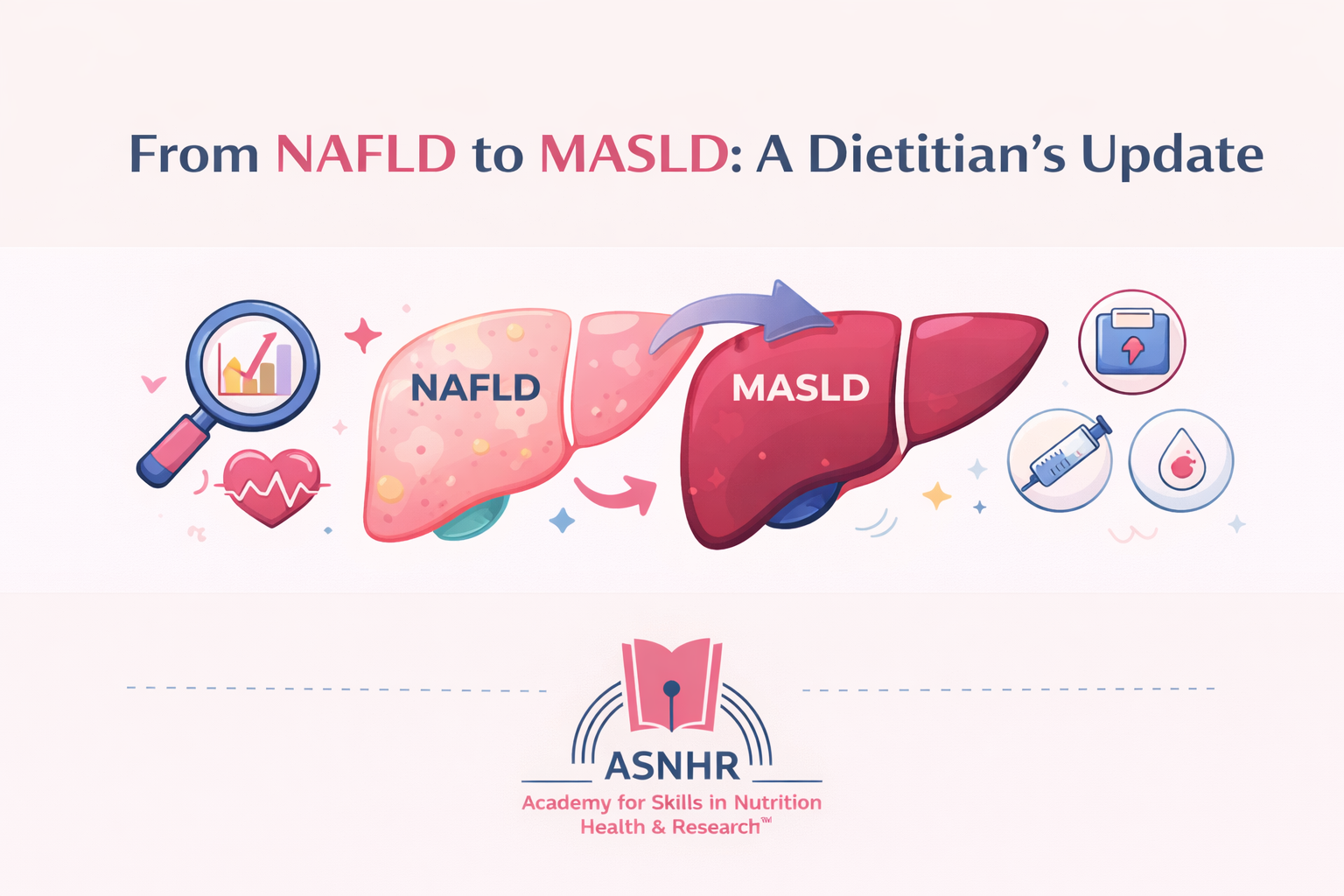
In hepatology, language matters, and a landmark shift has been in how we diagnose and understand fatty liver disease has arrived. Non-Alcoholic Fatty Liver Disease (NAFLD) has been officially redefined as MASLD: Metabolically Associated Steatotic Liver Disease. But this isn't just a renaming; it reflects a fundamental reframing of fatty liver disease as a metabolic condition.
With liver disorders becoming one of the leading causes of morbidity globally, and fatty liver affecting 1 in 3 adults, nutrition professionals are on the frontlines. This blog unpacks what MASLD is, why it matters, and what dietitians need to do now to align with the new diagnostic and dietary paradigm.
What Is MASLD and Why the Change?
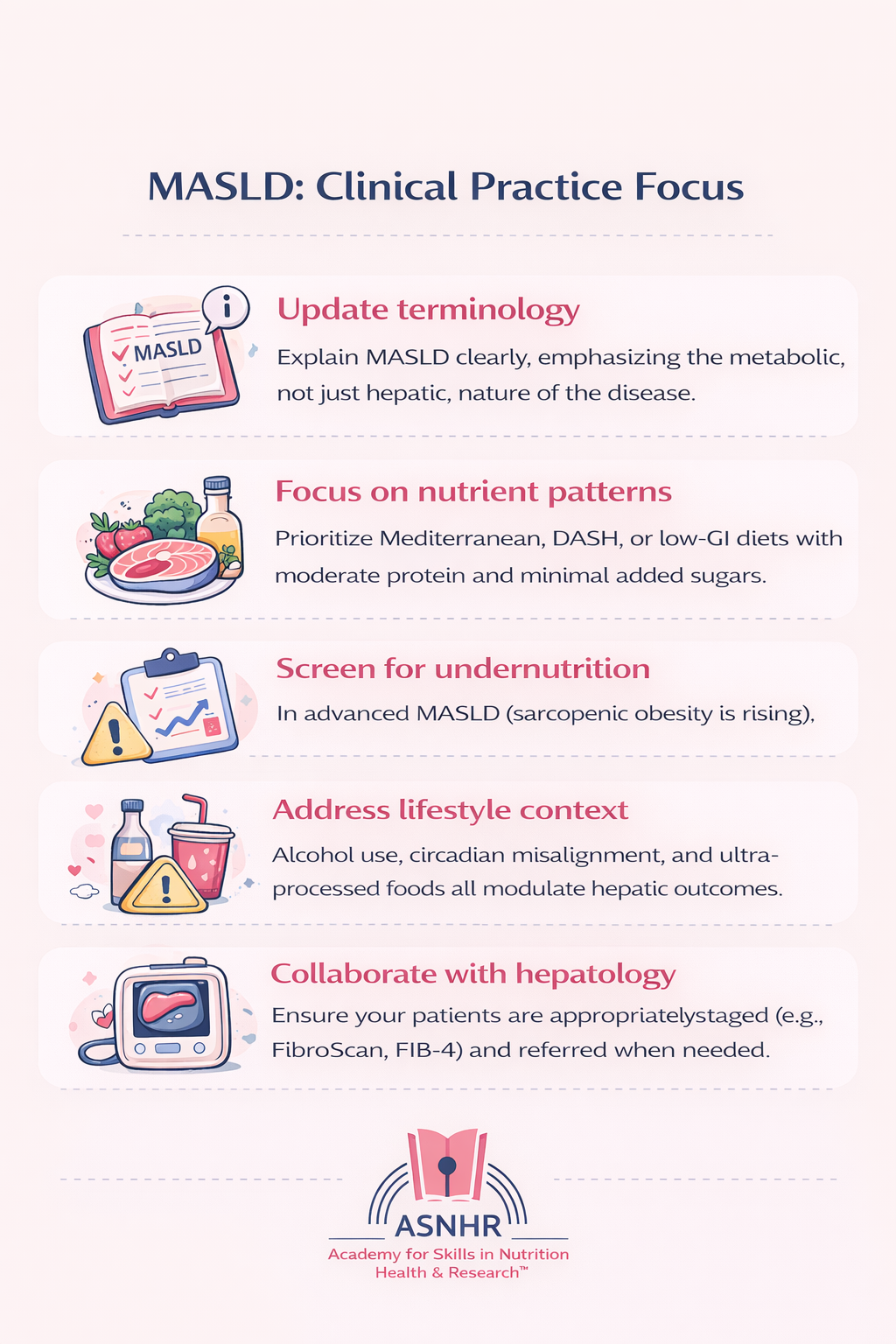
MASLD is now the umbrella term for hepatic fat accumulation not caused by significant alcohol use, but with evidence of cardiometabolic dysfunction such as obesity, insulin resistance, dyslipidemia, or hypertension. The diagnostic shift was prompted by recognition that: NAFLD excluded key metabolic risk indicators in its definition, language like ‘non-alcoholic’ stigmatized or confused patients, and New criteria better align with how metabolic disease and liver fat interact (Younossi et al., 2024). The redefinition isn't just semantic; it opens the door to more precise diagnosis, earlier intervention, and a stronger role for diet and lifestyle therapy as cornerstones of care.
Why Diet Matters in MASLD
MASLD is fundamentally a diet- and metabolism-driven liver condition. Hepatic steatosis develops due to energy surplus, insulin resistance, and inflammation. This triggers lipogenesis, mitochondrial stress, and immune activation in the liver, raising the risk of steatohepatitis, fibrosis, cirrhosis, and cardiometabolic disease. Weight loss remains the most potent therapy, but the focus is shifting beyond calories to diet quality, pattern, and insulin-sensitizing nutrients.
Dietary Strategies: What the Science Shows
Recent high-quality studies emphasize a few dietary patterns and interventions that dietitians should prioritize:
A meta-analysis in Nutrients (2024) confirmed that a Mediterranean-style diet rich in monounsaturated fats, fiber, polyphenols, and low in added sugars improves liver steatosis, insulin resistance, and cardiometabolic markers even without weight loss.
2. Time-Restricted Eating (TRE)
TRE (e.g., 8:16 or 10:14 fasting/feeding windows) may reduce liver fat independent of caloric intake. New RCT data (Jiang et al., 2024) suggest that 8-week TRE improved ALT levels and hepatic fat fraction in MASLD patients versus controls.
3. Low-Carbohydrate / Low-Glycemic Diets
Carb quality matters. Reducing refined carbs and added sugars, especially fructose, has direct benefits on hepatic fat and lipogenesis. Trials show that limiting carbs to <40% of energy or switching to low-GI foods improves ALT, insulin sensitivity, and fibrosis progression.
4. Anti-Inflammatory Components
Omega-3s (from fatty fish or supplements) reduce liver inflammation and triglyceride levels. Polyphenols from berries, green tea, and coffee exert antioxidant and antifibrotic effects.
Not All Calories Are Equal in MASLD
Emerging evidence suggests hepatic insulin resistance and steatosis are driven more by food quality than calories alone. A high-sugar, low-fiber diet can drive liver fat accumulation even in weight-stable individuals, whereas nutrient-dense, anti-inflammatory patterns can induce remission despite modest weight change (Eslam et al., 2024).
Final Word: Time for Dietitians to Lead the MASLD Movement
The rebranding from NAFLD to MASLD isn't just a name change; it’s a call to action for nutrition professionals. Diet is not just a supportive therapy; it’s a frontline treatment. And with precision nutrition strategies, MASLD remission is possible. Whether you're working in hepatology clinics or general wellness settings, it's time to reframe fatty liver as a metabolically-driven, nutrition-responsive condition and empower patients with food-first interventions that change outcomes.
MASLD Class LinkWant to learn more how to transform your approach to MASLD management with expert dietary and lifestyle strategies? Join our quick Masterclass on Optimizing Dietary and Lifestyle Strategies for Managing Metabolic Dysfunction-Associated Steatotic Liver Disease (MASLD) Masterclass. Click on the button above, enroll and start learning immediately
.1. Eslam, M., et al. (2024). The metabolic nature of MASLD: redefining the disease spectrum. Hepatology, 79(1), 123–136. https://pubmed.ncbi.nlm.nih.gov/38383845/
2. Younossi, Z., et al. (2024). From NAFLD to MASLD: Implications for diagnosis and management. Gastroenterology, 166(5), 1109–1123. https://pubmed.ncbi.nlm.nih.gov/38944463/
3. Alisi, A., et al. (2024). Impact of time-restricted eating on metabolic dysfunction-associated steatotic liver disease. Journal of Hepatology, 80(2), 415–427. https://pubmed.ncbi.nlm.nih.gov/38809396/
4. Jiang, S., et al. (2024). TRE and hepatic biomarkers: An 8-week randomized controlled trial. American Journal of Clinical Nutrition, 119(3), 483–492. https://pubmed.ncbi.nlm.nih.gov/38944461/
5. Takashi, K., et al. (2024). Low-GI dietary interventions in MASLD: Mechanisms and outcomes. Nutrients, 16(4), 753. https://pubmed.ncbi.nlm.nih.gov/38851997/
6. Fernández-Gómez, E., et al. (2024). Nutritional modulation of fibrosis in MASLD: A prospective cohort study. Clinical Nutrition, 43(1), 12–20. https://pubmed.ncbi.nlm.nih.gov/39126031/

Ms. Sara Sakarkute, Ms. Mugdha Deshpande
Ms. Sara Sakarkute, is a Master's student pursuing Nutrition and Dietetics with a focused interest in clinical nutrition and lifestyle-based interventions. She applies evidence-based nutrition principles to support preventive health, metabolic balance, and long-term well-being.
Ms. Mugdha Deshpande, RD, has submitted her PhD thesis in Health Sciences and has an advanced degree in nutrition and dietetics. She currently serves as a Research Scientist at Hirabai Cowasji Jehangir Medical Research Institute, Jehangir Hospital Pune.